
As we inch closer to the start of the school year, it is that time of the year when educators start planning to set up the classroom. Last year, I wrote the blog “Setting up your classroom with an Executive Function focus.” This year, I decided to share some ideas and examples of things I have seen educators do. During the past few years, I have been able to go into schools, visit classrooms, and talk with educators about how they set up their classrooms and how those thoughtful set ups support executive function development. Thank you to the staff at John F. Kennedy Elementary, in Spring Valley, Illinois, and my daughter who is a teacher in Smithville, MO, for allowing me to share these pictures from your clasrooms.
Schedules/Calendars
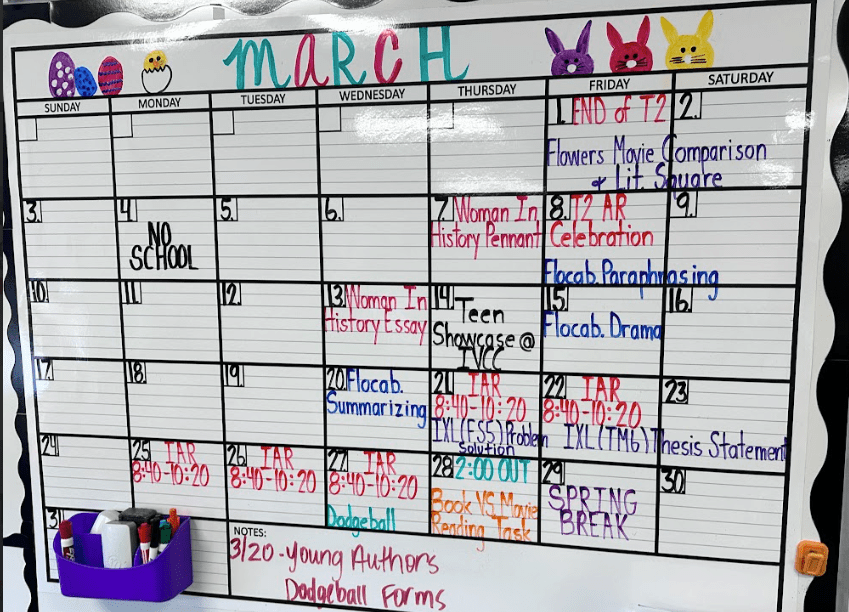
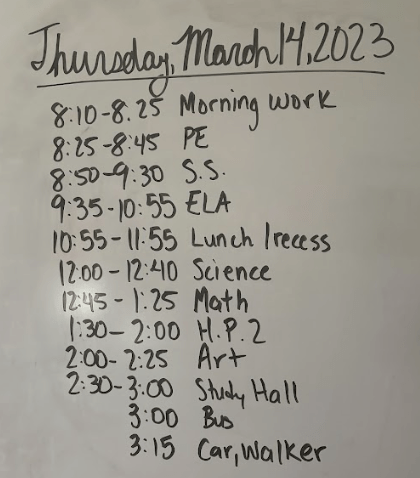
This may seem obvious, but we all do well when we know what is going to happen. Students are no different. Having a schedule or calendar posted for students to see and for you to review with them is a great way to discuss any anticipated changes and even to remind students that the day is a “normal” day with no changes. These schedules can be colorful or written on the board each day. The important thing to remember is to keep them in the same place so students know where to look, give them enough information but also make it short and easy to read, and last review it with them regularly. Don’t assume that they know it even late in the year. A quick, “Let’s look at our daily schedule, is anything different today?” “I don’t see anything either, so it is a regular day.” will go a long way for those students who need the grounding that a schedule review brings.
Timers
The use of timers in a classroom is a game changer. These can be used when students are to do independent work, during group time, when they are given time to clean up, or anytime you have a specified time period and you want the students to use that time in a specific way. There are many different timers and different ones will work well for different ages, and different situations. I often tell people if you are only going to change one thing in your classroom add a timer, it impacts almost every executive function skill in some way. In one classroom I was in this last year, the teacher gave the students 5 minutes at the end of the day to get packed up for going home. She turned on timer on YouTube that had a rollercoaster at the end. This was obviously a regular routine, because by the time the rollercoaster went down the hill, all the students had returned to their seats and had their hands in the air “riding” the rollercoaster. It was magical. They had independently completed what they were to do within the time limit given and the teacher did not have to say anything or remind anyone. The students were independent doing this and they were in 2nd grade.
Classroom Hub
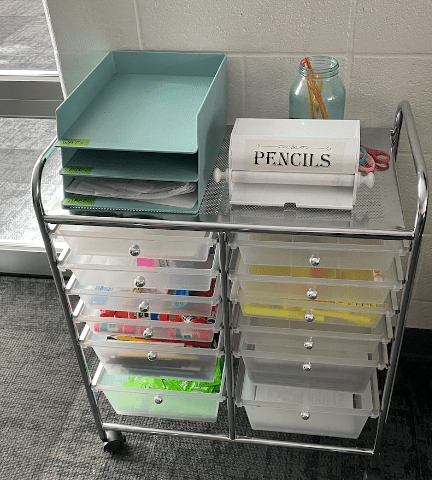
I am not sure what to call this next idea, so I am calling it a classroom hub. This is the place in a classroom that has items students can use independently when they need them. This will be different depending on the subject and grade level of the students, but the key idea is the students can easily access the items without having to get permission. Items could be pencils, pens, glue sticks, makers, etc. Other items for older students may include deodorant wipes, feminine products, body wipes, or other personal hygiene items. Are there rules to using the classroom hub, yes, but there is also a trust after the foundation is set that it will be used appropriately. Having a classroom hub allows the student to be independent in getting what they need without stopping the flow of the classroom.
Visuals
Visual supports are another strategy that I often recommend. When we talk, the words we say “disappear” as soon as we say them. When we use pictures or other visuals, they remain in their original location. This visual about visuals from Kristin Wiens at North Start Paths is one of my favorites and shows the many ways that visuals support the learning environment.

We all use visuals every day in all aspects of life, so when people tell me they used to have visuals for a student or a class, but “they know what to do, so they don’t need the visual anymore.” I push back with this example. If you have a regular place you go to get morning or afternoon caffeine, you know where that store is, and you know how to get there. Imagine one day, the signage for that store was just gone. A few things could happen.
- You could miss the turn off because you did not have the visual reminder of where to turn.
- You might see the sign is gone and assume the store is closed.
- You may go into total panic mode because you are sure the store is closed. You worry that you won’t get your needed caffeine, and if you go somewhere else, you will now be late for work, your boss will fire you, your family will lose their house . . .
That last example is extreme, but if a person has severe anxiety, these are the stories that may play in their head. The reality is the sign was just being replaced and nothing else has changed. However, because the visual of that store being there and being open was gone, you filled in the blanks. Reality is visuals reduce our anxiety and give us a way to check that things have not changed and that we can use our cognitive skills on other things. So don’t assume that your student or class no longer need the visual supports. Keep them in place and know they will use then when and if they need them.
 Buckingham Educational Services & Training, LLC